
Film notes
ALEXANDRE PROMIO I: TWO FREE-STYLE PROGRAMMES
They should be called Promio films, not films by the Lumière brothers! “There is no doubt that at least a third of the vues in the Lumière Catalogue are by him” (Lumière Catalogue, 1995). For those who are interested in statistics: of the 1428 titles in the Lumière catalogue about 800 are not attributed to anyone, 350 are attributed to Alexandre Promio, 34 to Louis Lumière and just one to Auguste Lumière.
Alexandre Promio (1868-1926) entered the Lumière company on March 1, 1896. Entrusted with directing the department of cinematography, he trained the cameramen who subsequently went abroad; he himself travelled for most of 1897. While the first Lumière films (the most famous ones) by Louis Lumière have a carefree holiday mood of friends meeting, beloved infants and pets playing, the vues by Alexandre Promio are visual sensations of speed, light and shadow, depth, composition and movement.
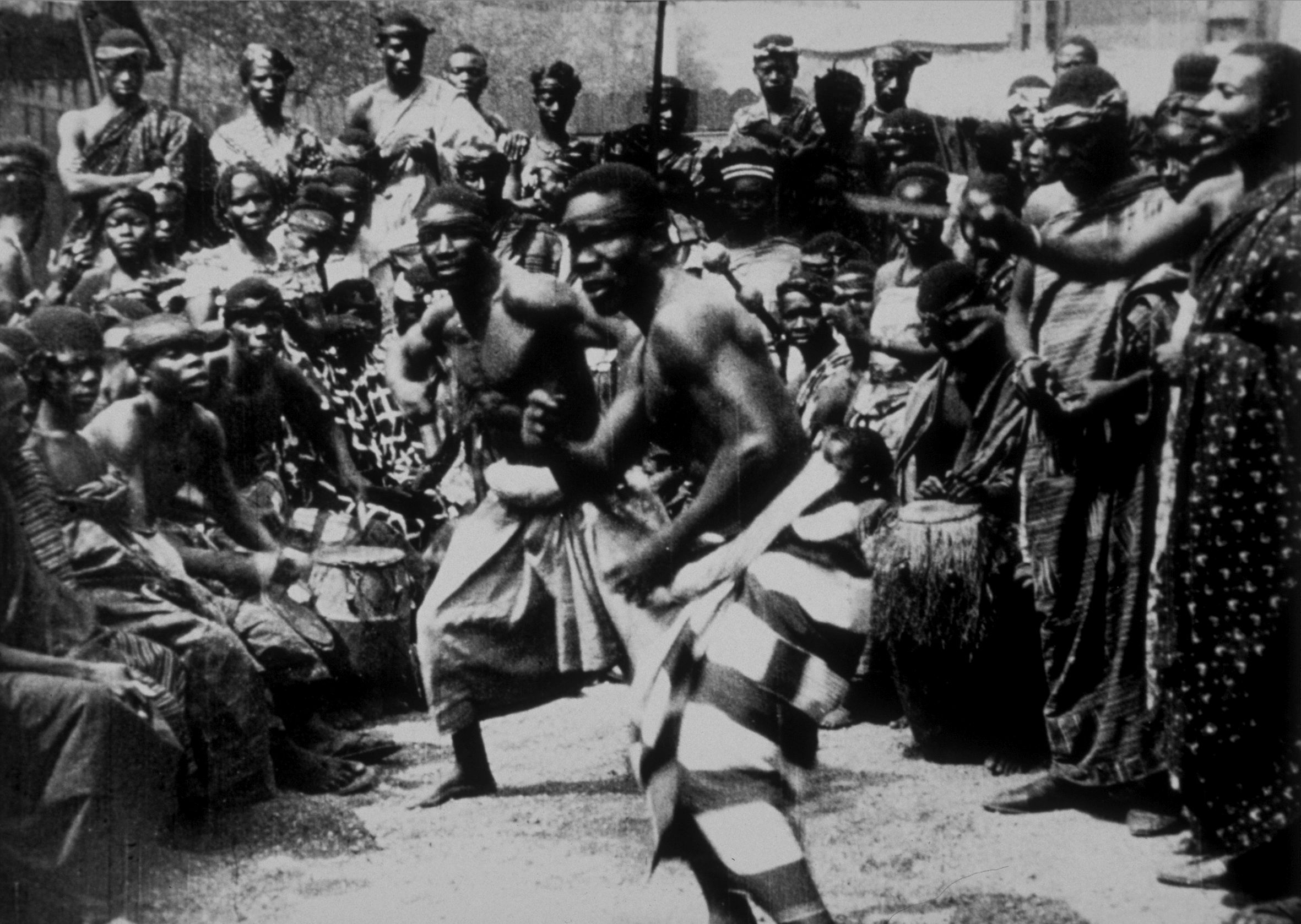
The two programmes are made up mainly of views by Promio, many of them taken from trains or ships in motion. For contrast, the first one includes three clown bits and a sketch, and the second one four dances by Ashanti.
Mariann Lewinsky
THE LUMIÈRE AFRICA CORPUS OR AFRICA’S ‘ROYAL’ ENTRY IN THE CINEMA
Let us start with questions: what would it mean to write the history of cinema from the perspective of those to whom it has long been unkind? What would it mean to revisit film history with Africa as a point of departure? Would it underscore the fundamental perspectivalism of film historiography? Would it unearth a problematic will and claim to universalism? Would such a gesture open up the possibility of saying something new? About the Lumière? About the place of Africa in cinema?
These are questions we invite you to ponder along with us through this program culled from the ‘Lumière Africa Corpus’, a group of one hundred some views shot by the Lumière brothers in, on and about Africa in the early years of the cinema, that is, 1896, 1897 and 1903, as they sent their operators across their own country, across Europe and the world to spread the “Gospel according to the Cinématographe”.
The Lumière Africa corpus consisted principally of two major genres, the travelogue (and its subgenres) and the menimal genre, which is at once a genre, a mode of filmmaking and a regime of visuality. These two categories perfectly fit the two Lumière programs we propose for your attention to commemorate their relationship to Africa in the year 1897, i.e. Alexandre Promio’s Egyptian Travelogues and Menimals: Filming ‘Ashantis’ in Lyon.
Dixit John Grierson: “I always think of documentary as having fundamental chapters. The first chapter is of course the travelogue”. One of its masters is without any doubt Alexandre Promio, the most prolific Lumière operator, who shot the majority of the Lumière views on the African continent – in Algeria, Tunisia and Egypt. During his stay in Egypt, he contributed to the production of cine-Orientalism, enshrined the Lumière ‘official’ and ‘embedded cinema’ traditions, and experimented with film language through an exploration of staging-in-depth, cinematic narrativity and filmic temporality.
The menimal genre/mode/regime of visuality is one in which the frontiers between human beings and animals are blurred; where humans are put on the same continuum as animals, foregrounding the bestial to the detriment of the human. This important category of the Lumière corpus reaches its apex in the Lumière views of the Ashanti Village in Lyon shot between April 17th and July 20th, 1897. In them, the pseudo-scientific discourse and practice of racial hierarchization, articulated with a tradition of mass spectacle fanatically committed to the display and commerce of alterity, collude with the Cinématographe to produce ‘moving’ images that help convince European audiences of the necessity and desirability of the colonial project while protecting them from the sensory overload of a restless and highly velocious modernity that threatens to shake the ground under their feet. In the process, they create nightmarish images (images-cauchemar) that still haunt many an African filmmaker and spectator today.
Aboubakar Sanogo